

Zombie data: why AI agents trust stale records
An AI agent on your data platform answers with the same confidence whether the record it read is current, abandoned or duplicated. Nothing i…

This series covers how Snowflake® and VaultSpeed work together, one industry per post: the business problem, the architecture, and what changes once it is in place. Financial services goes first, because few industries are as strict about getting a number right and proving where it came from.
In short: Snowflake gives people and agents governed access to financial data, and VaultSpeed keeps the data model, lineage and code beneath it correct. VaultSpeed's agents propose mappings and changes, and its generators write a Data Vault as runtime-free SQL or dbt in the institution's own Git repository. Snowflake semantic views and Cortex Agents answer on top. When a reporting rule changes, the work lands as one reviewed release, with lineage from every reported figure back to the source system.
Banks and insurers run on dozens of systems: core banking, trading, policy administration, claims, actuarial engines and the general ledger, plus whatever arrived with the last acquisition. Regulatory reporting, risk dashboards and new data products all depend on integrating those systems correctly and keeping a full history.
In most institutions that integration lives in years of hand-written SQL and ETL, next to a data model that went stale the moment coding started. The platform was built twice, once as a data model and once as code, and the two drifted apart. When a source system changes or a reporting rule moves, the work starts with archaeology.
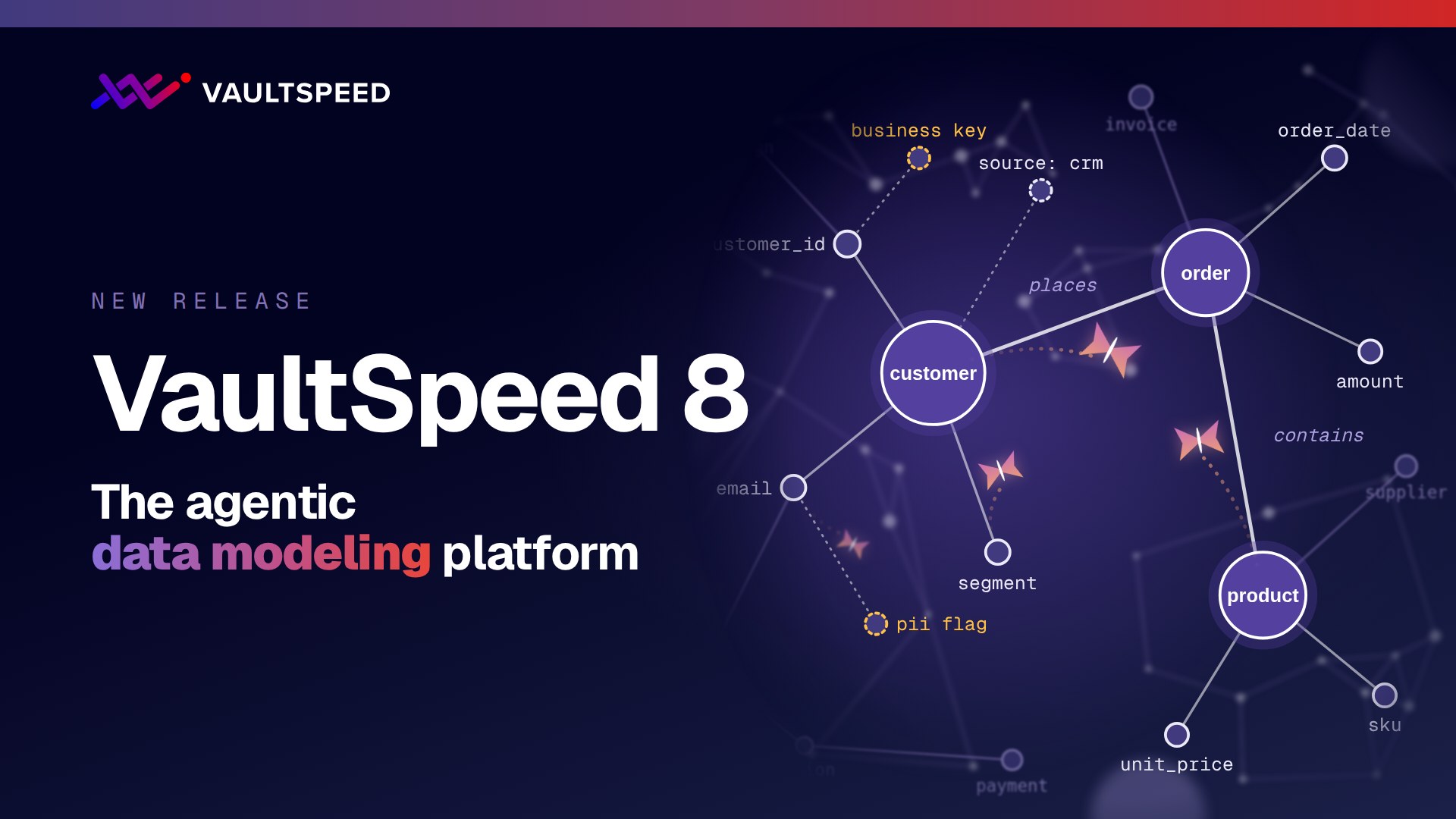
VaultSpeed is an agentic data modeling platform: bring AI to data modeling and automate the code. Agents analyze the sources, propose mappings to business concepts such as Customer, Account, Policy, Claim and Instrument, and draft semantic views and data products.
The context store holds the result as one governed graph: the business data model, the physical implementation with its loading logic and lineage, and the data products on top. Generators then write the code from that graph.
In regulated finance the integrated layer is often a Data Vault, generated deterministically, so the same input gives the same code on every run and full history is kept by default. The output is runtime-free SQL or dbt in the institution's own Git repository, and the team reviews and approves every change.

Snowflake is where that code runs and where people ask their questions. The gold layer is published as Snowflake semantic views, so metrics such as capital ratios or claims frequency are defined once.
Cortex Agents combine Cortex Analyst over those views with Cortex Search over credit memos, policy wordings and adjuster notes. So a risk manager in Snowflake CoWork (formerly Snowflake Intelligence) can ask why exposure moved on a portfolio this quarter and get an answer that traces back to the source system.
Engineers work from the same context: Snowflake CoCo (formerly Cortex Code), or any other agent, queries the VaultSpeed context store over MCP. VaultSpeed runs its data plane in the institution's own cloud and works from metadata, and the institution chooses which LLM its agents use.
The difference shows when a reporting rule changes. Say the regulator asks for exposures broken down by collateral type from next quarter. VaultSpeed's agents read the new requirement, check the context store for what already exists, and propose the changes: a new attribute on the Collateral concept, its mapping from the collateral system, and an updated semantic view for the report.
The change report lists every affected object, the generator writes the code, and it all lands as one pull request that the data team and the agents review together. Once it merges, Snowflake's agents pick up the new semantic view, and the risk manager can ask for the new breakdown in CoWork the same day, with lineage back to source.
One set of agents builds the data; the other answers on it. An acquired loan book follows the same path, as Figure 2 shows.

Thomson Reuters runs a unified Data Vault layer on Snowflake, generated with VaultSpeed, to bring more than 100 business systems together and absorb continuous M&A. Eleven data products are live, the legacy enterprise data warehouse is beginning its phased decommissioning, and new acquisitions arrive with limited rework, keeping the program on schedule.
That split holds for the rest of the series: Snowflake gives people and agents governed access to the data, and VaultSpeed keeps the data model, lineage and code beneath it correct. Healthcare and life sciences is next.
VaultSpeed is available as a Snowflake Native App on Snowflake Marketplace, so you can install it in your own Snowflake account and start the 30-day free trial straight from the listing. To see how the agents work before you install, take a look at the platform or the VaultSpeed and Snowflake page.
Snowflake gives people and agents governed access to the data, and VaultSpeed keeps the data model, lineage and code beneath it correct. VaultSpeed generates the integrated layer as runtime-free SQL or dbt, and Snowflake runs that code and publishes the gold layer as semantic views.
In regulated finance the integrated layer is often a Data Vault, generated deterministically, so the same input gives the same code on every run. Full history is kept by default, so regulators and auditors get full history and lineage for every reported figure.
VaultSpeed's agents read the new requirement, check the context store for what already exists, and propose the changes. The generator writes the code, and it all lands as one pull request that the data team reviews. Once it merges, Snowflake's agents pick up the new semantic view the same day.
Yes. A risk manager in Snowflake CoWork can ask why exposure moved on a portfolio this quarter, and a Cortex Agent answers from semantic views built on the VaultSpeed-generated Data Vault. Lineage traces the answer back to the source records.
VaultSpeed runs its data plane in the institution's own cloud and works from metadata. The institution chooses which LLM its agents use.
VaultSpeed is available as a Snowflake Native App on Snowflake Marketplace. You can install it in your own Snowflake account and start the 30-day free trial straight from the listing.
Click here.
An AI agent on your data platform answers with the same confidence whether the record it read is current, abandoned or duplicated. Nothing i…
Patrick Van Deven, CEO
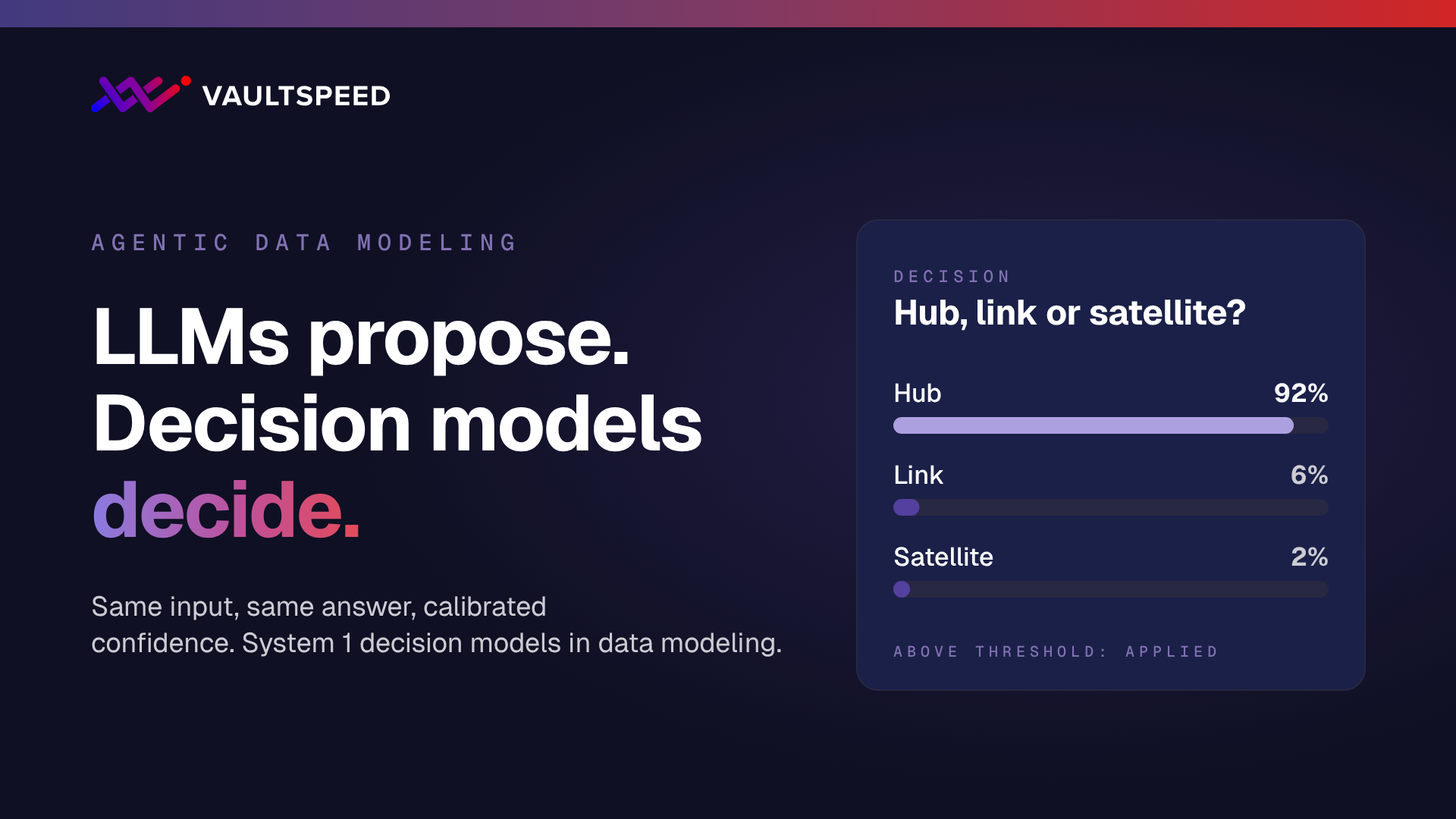
Ask an LLM to design a Data Vault for 13 tables from a bank's core banking, card and risk systems, with names like LOAN, COLLATERAL and COUN…
Bring a source system and a question. We connect the context store to it and show you what the agents propose.
Talk to us