
Financial services on Snowflake: governing regulated data
This series covers how Snowflake® and VaultSpeed work together, one industry per post: the business problem, the architecture, and what chan…

Many insurers already run analytics on Databricks. This article shows how a data model can drive the code that loads that lakehouse and keep its logic in step with the source systems: what that looks like in a Databricks workspace, where it helps most, and where people stay in charge.
In short: Most insurance data platforms get built twice, once as a data model and again as the code that moves the data, and the two drift apart. With VaultSpeed, the definitions live in one data model in the enterprise context store, and the code that loads the Databricks lakehouse is generated from it. A change becomes one reviewed update in one place, and a reviewer can follow every figure in a return back to its source field. Only metadata reaches VaultSpeed, and the data stays in your workspace.
Most insurance data platforms get built twice: once as a data model that describes the business, and again as the code that moves the data. First the business agrees what a policy, a producer or a claim means. Then engineers turn that agreement into code.
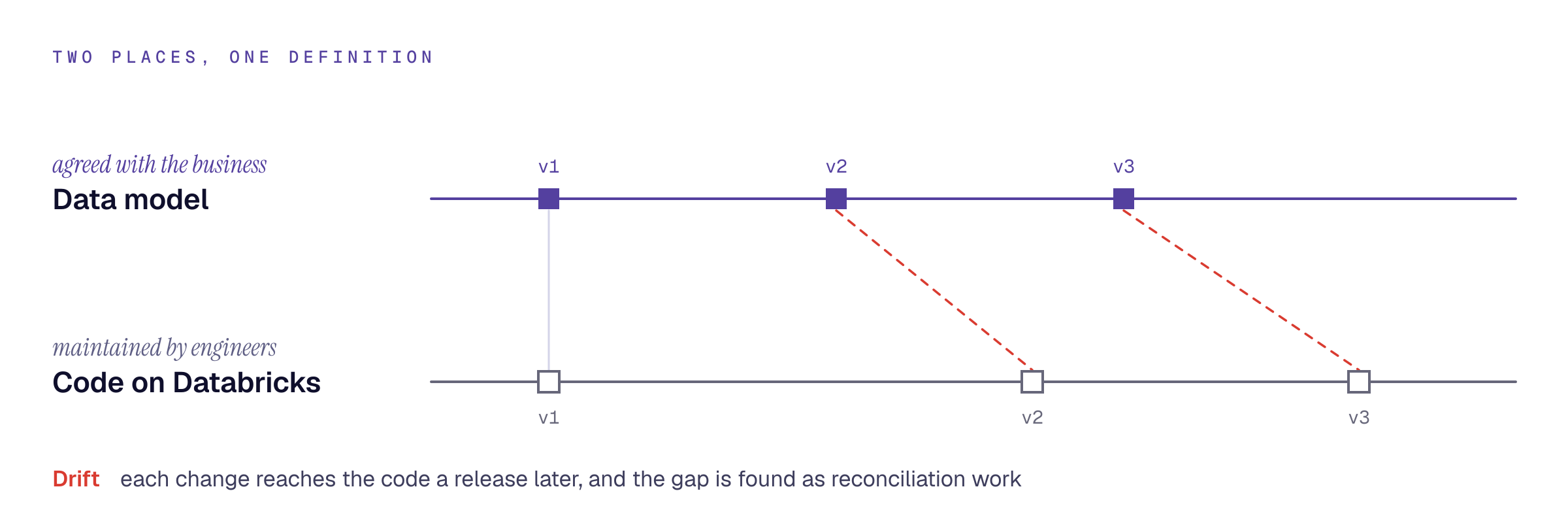
The two drift apart from the first sprint. A definition changes in the data model, the code changes in a later release, and the gap shows up as reconciliation work. Tables on Databricks that were built on an old definition keep serving reports until someone finds them.
Insurance makes this worse. Agency codes, rating factors and reserves each turn up in more than one system, from policy administration and rating to claims and the finance ledger, and each system defines them its own way.
Insurers feel this most during change. A new product, a migrated policy administration system or a revised reporting requirement touches many definitions at once. Each one has to be found, updated and checked in every place it lives.
On a lakehouse the gap usually shows in the silver layer. Landing raw data in bronze is the easy part. Silver then gets defined per project: each team integrates the sources it needs on its own terms, and the same policy and claims data is integrated several times over.
The approach in this article rests on one principle: the definitions live in one data model, and the code that loads the lakehouse is generated from it. This is how VaultSpeed, an agentic data modeling platform, works. The business is modeled top down, the technical metadata of the source systems is harvested bottom up, and the match between the two is kept as metadata: structures, keys, relationships, mappings and lineage.
That metadata lives in the enterprise context store (ECS), a metadata graph that holds the data model in machine readable form. The graph links three contexts.
| Context | What it holds | At an insurer |
|---|---|---|
| Business context | The definitions the organization has settled on, independent of any technology | Policy, producer, claim and exposure, and how they relate. An industry data model such as ACORD can be the starting point. |
| Implementation context | The physical objects, the loading logic and the lineage across bronze, silver and gold | The policy administration tables, the Data Vault built from them, and the gold tables that read from it |
| Data product context | The data products, their contracts and their semantics | Loss ratio by line of business, with the definition of incurred it uses |
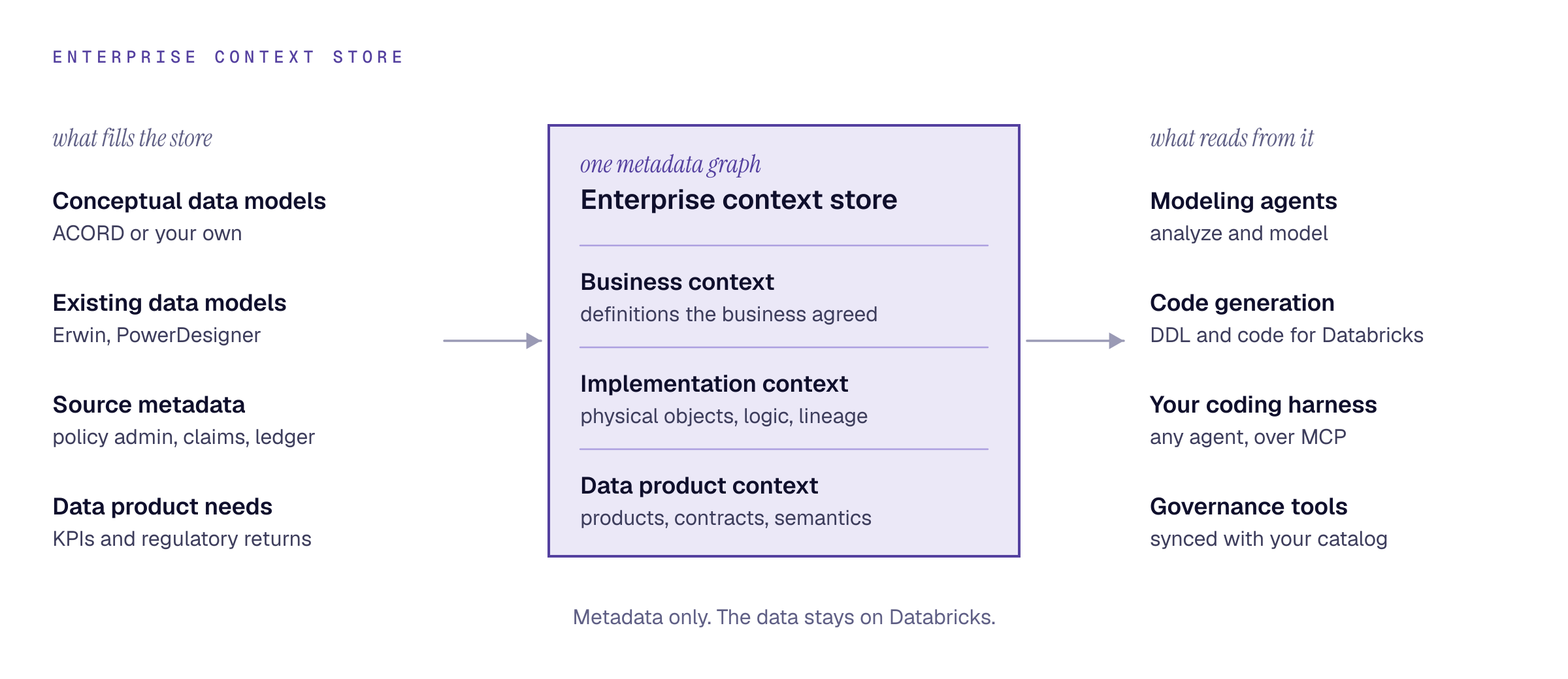
Because the data model is machine readable, a change to it regenerates the code that depends on it. A change becomes one reviewed update in one place, and engineers can query the same definitions over MCP from the tools they already use. The same data model can also generate code for another platform, which turns a migration into a regeneration of the code.
Take an insurer whose policy administration, claims, billing and finance data already lands in a Databricks workspace. The data model adds an integrated silver layer and the gold tables on top of it, one layer at a time.
| Layer | What the insurer gets on Databricks | How the code is produced |
|---|---|---|
| Bronze | Delta tables with the policy, claims, billing and ledger data as it landed. Tables that are already in Databricks can be read as a source. | Agents write the landing and staging code, and the team reviews it in Git. |
| Silver | A Data Vault with full history: one policy, one producer and one claim across all systems. | Rules and templates, with no LLM in the code path. The same data model gives the same code on every run. |
| Gold | Star schemas and data products that read from silver, such as loss ratio by line of business and reserve movements. | Agents generate it from the data product definitions, and the team reviews it in Git. |
In the workspace, that comes down to four things.
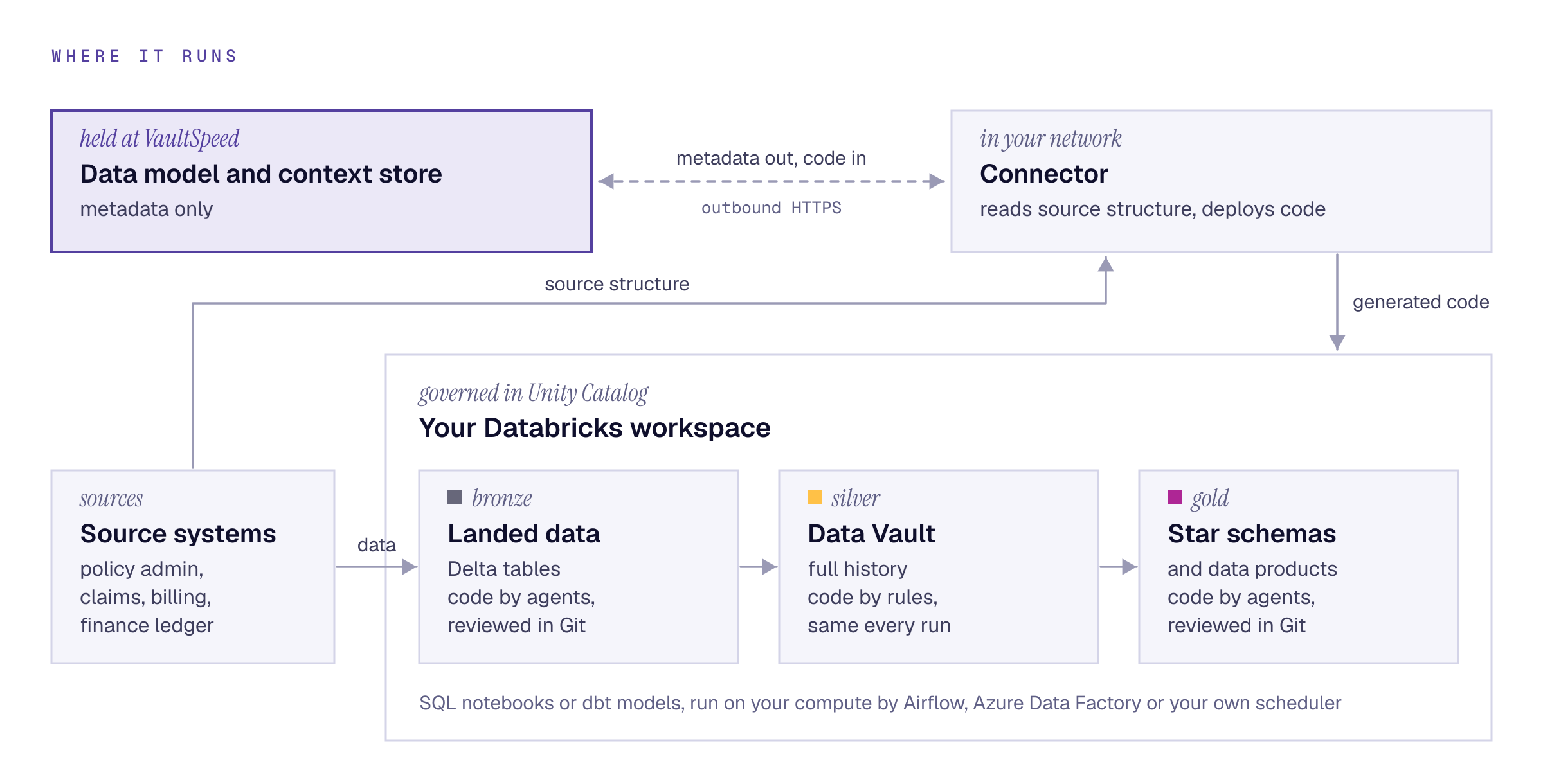
The generated code is yours: it runs on its own, independently of the subscription. You also choose the LLM, your own provider or inference through VaultSpeed, and the rule based silver code involves no LLM either way.
AI goes on the analysis and the modeling. Agents profile sources, propose the data model and the mappings, convert existing data models and make repetitive changes. They work on the data model and on the code generated from it, and they do not run business processes such as claims handling or payments.
Every agent session runs in an ephemeral sandbox, with no standing warehouse credentials and a spend cap set at platform level. Changes are versioned in Git, and teams and agents review each other's work before a change ships.
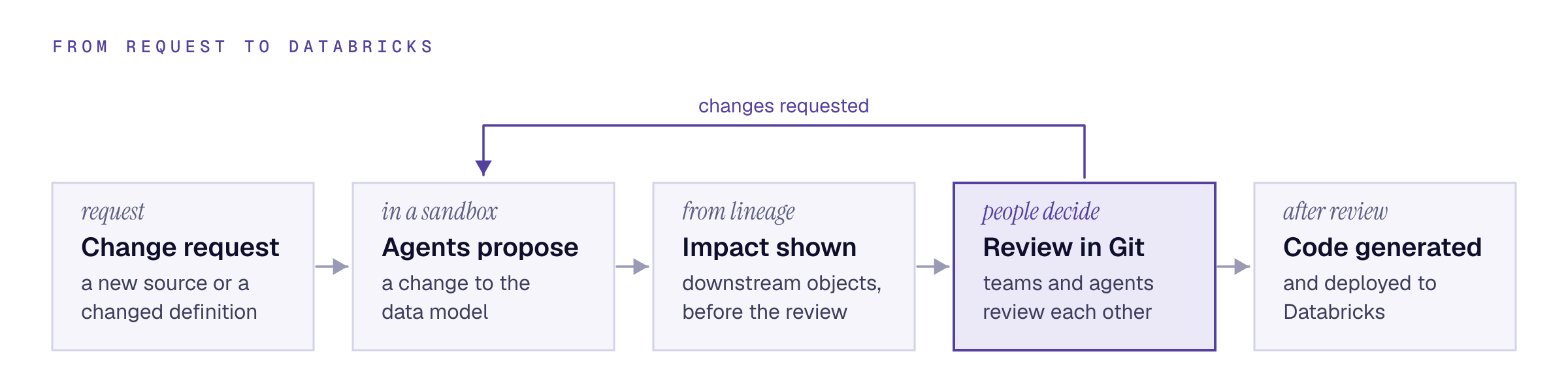
| Agents do | People decide |
|---|---|
| Convert an existing data model, for example from Erwin or PowerDesigner, into the context store, and flag where its definitions differ from the source systems. | Which definition of a policy, producer or claim is correct for the business. |
| Profile a new source, propose the data model and mappings for it, and show the lineage the generated code will create. | Whether that proposal is accepted, changed or rejected. |
| Check a proposed change against lineage, and show which downstream objects it affects. | When the change ships, through review in Git. |
| Answer engineers' questions about the data model over MCP. | What those answers mean for a regulatory filing or a financial statement. |
Regulatory interpretation, sign-off and compliance decisions stay with the insurer and its advisers. The data model makes the evidence easier to produce. It does not decide what the regulation requires.
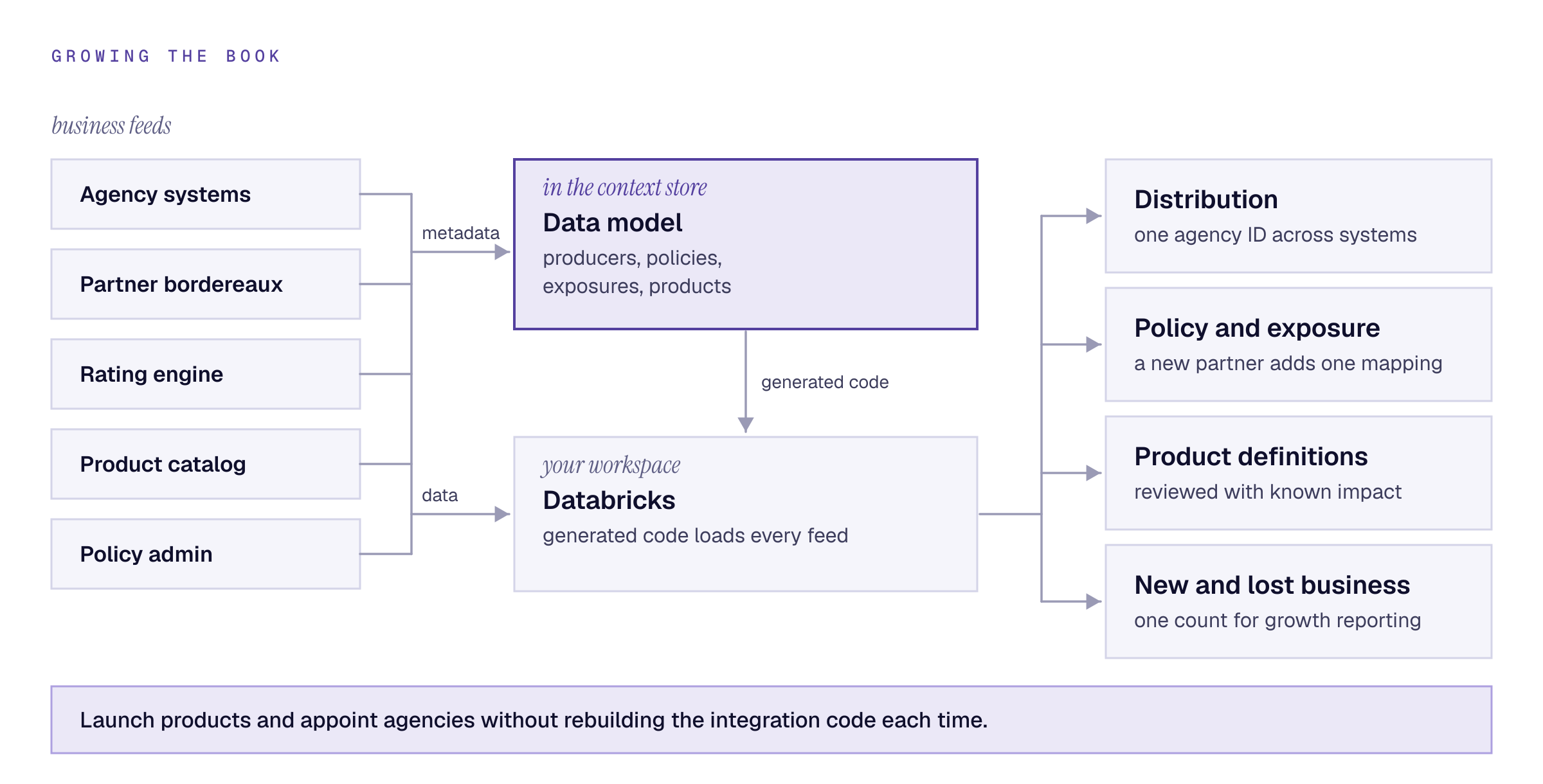
Growth work starts with data that describes producers, policies, exposures and products. When those definitions live in several places, analysts spend their time reconciling them.
On Databricks, each feed lands in bronze and is mapped once to the data model. When a new agency or delegated authority partner starts sending bordereaux, the team adds one mapping, and the Data Vault in silver absorbs the new source without a redesign of what is already there. The gold tables for distribution and growth reporting keep reading the same producer and policy.
In regulatory and audit work, traceability matters more than speed. The lineage is derived from the data model and its mappings, so nobody has to reconstruct it from the code afterwards. A reviewer follows a figure that feeds a return from the gold table back through silver and bronze to the source field.
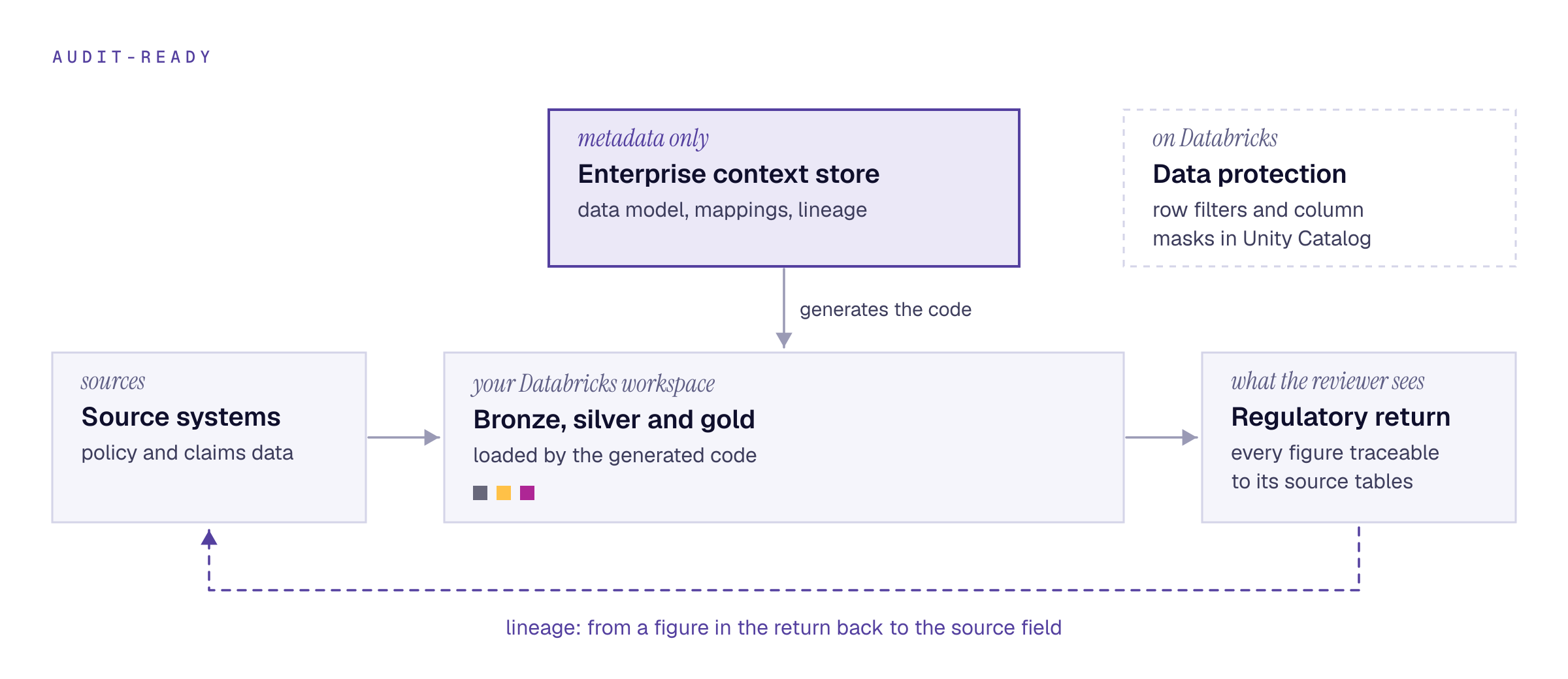
Lineage supports governance review. It does not certify compliance. Controls on access and data protection, such as Unity Catalog row filters and column masks, are applied on Databricks.
Finance teams spend a large share of each close reconciling figures before any analysis starts. Reconciliation is easier when each measure is defined once. Incurred, paid and reserve each get one definition in the data model, and every variant the insurer keeps on purpose gets its own name.
On Databricks, the gold tables behind loss ratio by line of business and reserve movements all read those definitions, so the dashboards and Genie spaces built on gold start from the same numbers.
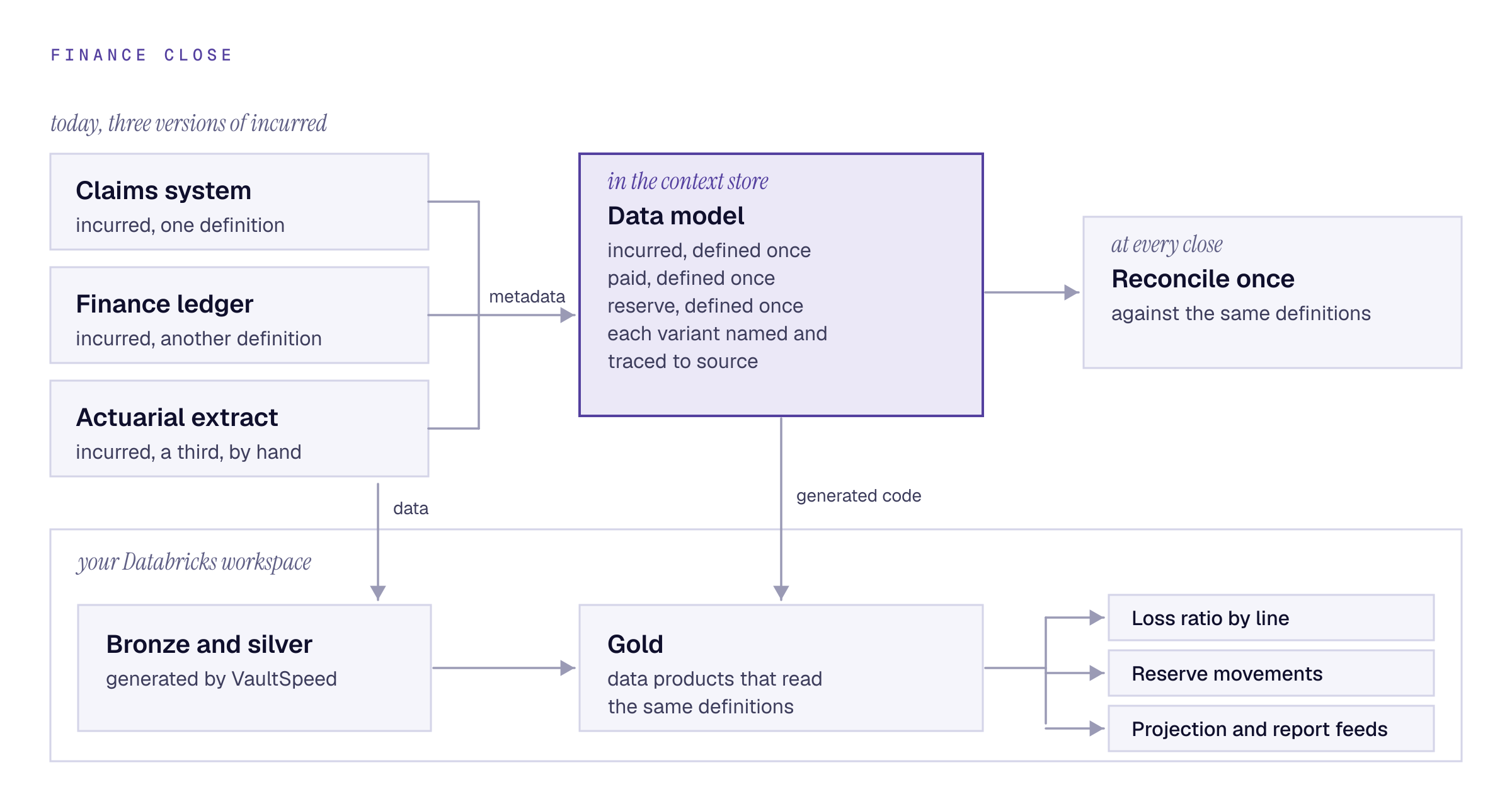
Start with one definition that the business already disputes. Trace it through the data model, the code and the reports. The gap you find is the place to begin.
Next step: see how VaultSpeed runs on Databricks on the VaultSpeed and Databricks page, or at docs.vaultspeed.com. To see how the agents work, take a look at the platform.
First the business agrees what a policy, a producer or a claim means. Then engineers turn that agreement into code. The two drift apart from the first sprint, and the gap shows up as reconciliation work.
The enterprise context store (ECS) is a metadata graph that holds the data model in machine readable form. It links three contexts: business context, implementation context and data product context.
No. A connector in your network reads the structure of the sources, meaning table names, columns, data types and keys, and deploys the code. Only metadata reaches VaultSpeed, and the data stays in your workspace.
No. The silver Data Vault is generated from rules and templates, with no LLM in the code path, so the same data model gives the same code on every run. For the agents, you choose the LLM: your own provider or inference through VaultSpeed.
Agents profile sources, propose the data model and the mappings, convert existing data models and make repetitive changes. People decide which definition of a policy, producer or claim is correct for the business, whether a proposal is accepted, and when a change ships, through review in Git.
No. Lineage supports governance review. It does not certify compliance. Regulatory interpretation, sign-off and compliance decisions stay with the insurer and its advisers.
This series covers how Snowflake® and VaultSpeed work together, one industry per post: the business problem, the architecture, and what chan…

An AI agent on your data platform answers with the same confidence whether the record it read is current, abandoned or duplicated. Nothing i…
Patrick Van Deven, CEO
Bring a source system and a question. We connect the context store to it and show you what the agents propose.
Talk to us